BIOPHAM Master – Track 1: Pharmaceutical Materials Science
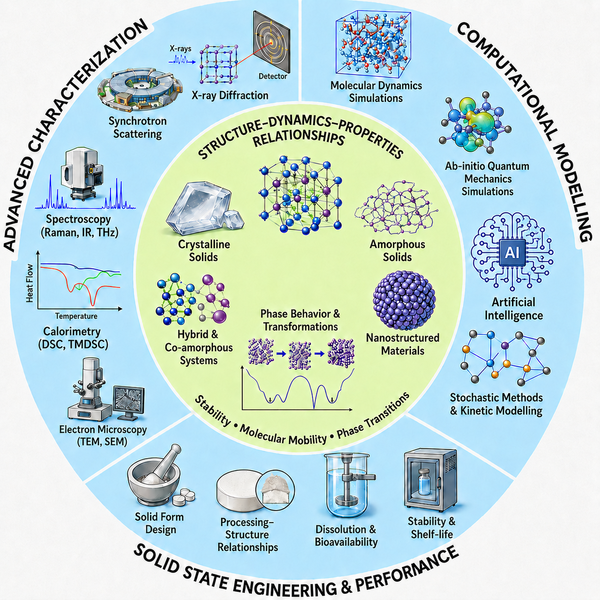
Track 1 of the BIOPHAM Master, Pharmaceutical Materials Science, offers an interdisciplinary training pathway dedicated to the understanding, characterization, modelling, and development of materials used in pharmaceutical applications. The syllabus combines physics, materials science, chemistry, pharmacy, computational modelling, artificial intelligence, and advanced experimental characterization. It is designed to provide students with a strong scientific foundation while progressively guiding them toward specialized expertise in pharmaceutical materials, drug formulation, solid-state properties, amorphous systems, molecular mobility, and advanced analytical techniques. The track is delivered jointly by the University of Lille in France and the Polytechnic University of Catalonia in Spain, reflecting the international and multidisciplinary spirit of the BIOPHAM programme.
The programme is organized over three academic terms, each corresponding to 30 ECTS credits. The first and third terms take place at the University of Lille, while the second term is hosted by the Polytechnic University of Catalonia. Across these terms, students follow a structured progression: they first acquire fundamental concepts in physics, materials science, pharmacy, and modelling; then broaden their knowledge through soft matter, crystallography, large-scale facilities, stochastic methods, and internship experience; and finally specialize in advanced pharmaceutical materials science through dedicated courses on thermodynamics, amorphous materials, thermal analysis, spectroscopy, microscopy, diffraction, and pharmaceutical technology.
Term 1 – Foundations in Pharmaceutical Materials Science (University of Lille, France)
Term 3 – Advanced Specialization in Pharmaceutical Materials (University of Lille, France)
Learning Outcomes and Professional Preparation
By completing Track 1, students develop a comprehensive understanding of pharmaceutical materials while gaining broader insight into other classes of functional and molecular materials. They learn how structure, dynamics, thermodynamics, processing, and formulation determine the behaviour and performance of drug substances, drug products, and related material systems. They acquire practical skills in laboratory experimentation, data analysis, computational modelling, machine learning, scientific communication, and research methodology.
Graduates of the track are prepared to work in academic research, pharmaceutical research and development, formulation science, materials characterization, computational materials science, quality control, advanced analytical facilities, and broader materials-oriented sectors. The syllabus equips them to address key challenges in pharmaceutical materials science, including polymorphism, amorphous stability, drug solubility, controlled release, physical transformations, formulation design, and the integration of experimental and computational approaches, while also providing transferable concepts and methods applicable to polymers, soft matter, biomaterials, molecular crystals, nanomaterials, and other advanced non-pharmaceutical materials.