The “Track 2 Biomaterials for Pharmaceutical Applications” will cover the fundamental principles of biomaterials, with a focus on their design, characterization, and applications in healthcare and pharmaceutical sciences (see Figure). In 2023, the Biomaterials market was valued at approximately $178 billion and is projected to grow at a compound annual growth rate (CAGR) of around 15.6% from 2024 to 2030, with a growing share of the market coming from emerging technologies like 3D printing and nanomaterials. As the healthcare landscape continues to evolve, the demand for more sophisticated biomaterials, particularly in areas like regenerative medicine, drug delivery, and personalized treatments, including cancer ones, experts able to deal with such a complex and multidisciplinary scenario are becoming strategic. The students of this track will gain an understanding of the structure-property relationships of biomaterials, including natural, biotech and synthetic origin, their interactions with biological systems, and their role in advancing innovative healthcare solutions, including drug delivery systems on different scales (nano-micro-macro), implants, and tissue engineering scaffolds. Innovative technologies, such as electrospinning, 3D and 4D printing and bioprinting, along with conventional technologies (e.g., emulsions, freeze drying) and hands-on laboratory experience, regulatory and sustainability aspects, will inspire the students to next generation pharmaceutical biomaterials. By the end of this training track, students will be able to: i) know the advanced (bio)fabrication techniques (from macro-to-nanoscale), the modern analytical, structural and imaging techniques for characterization of biomaterials, and the most important regulatory aspects for clinical translation; ii) understand the key properties of biomaterials and their relevance to biomedical applications, including the interactions between biomaterials and biological systems and biocompatibility, iii) explore the applications of biomaterials in drug delivery, regenerative medicine, and pharmaceutical technologies, and iv) develop skills in selecting and designing biomaterials for specific medical and pharmaceutical purposes.
Term 1 – Foundations in Biomaterials for Pharmaceutical Applications (University of Pisa, Italy)
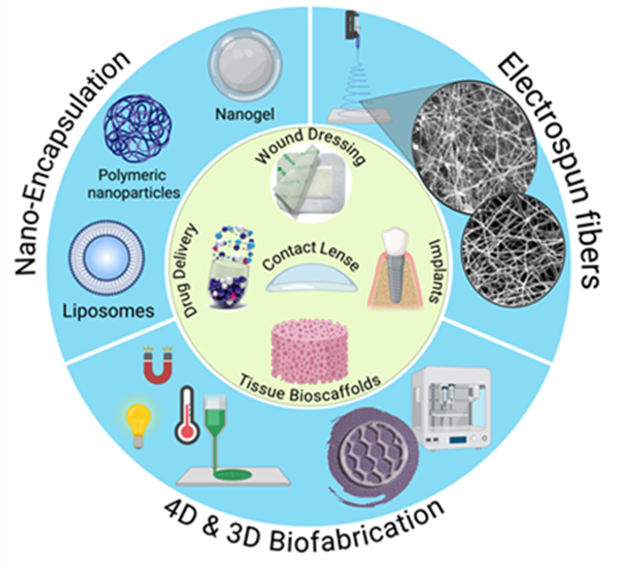
Schematic representation of materials, systems & methods covered in Track 2