The “Track 3: Molecular Science for Pharmaceutical Applications” will focus on training students to understand, at the molecular level, the physical principles that govern the structure, dynamics, and interactions of biomolecules and pharmaceuticals. This knowledge is crucial for designing more effective drugs, improving drug delivery, and developing new therapeutic strategies, providing a foundation for the next generation of researchers and professionals working in drug design, nanomedicine, and biopharmaceuticals. Biopharmaceuticals are among the most sophisticated medicines and are becoming increasingly prominent in the pharmaceutical industry. Some companies are already allocating 40% or more of their R&D budgets to biopharmaceuticals, which are expected to dominate future product usage and sales.
However, compared to conventional chemical drugs, therapeutic proteins face significant challenges due to their intrinsic instability. This has resulted in a strong focus on developing highly stable biopharmaceutical products, particularly solid formulations with enhanced performance. Moreover, companies incur substantial trial-and-error costs in pharmaceutical development, stemming from the absence of a rational approach based on a comprehensive, multi-dimensional understanding of these materials. To address the challenges posed by the physical and chemical instability of protein-based therapies, as well as the limited solubility of synthetic drugs, the demand for targeted delivery, reduced toxicity, and ensuring long-term efficacy, the industry has a high demand for professionals with strong fundamental knowledge in biophysics and material science to address these complex issues effectively (see Figure). This includes expertise in formulating solid forms using advanced drying techniques such as freeze-drying, spray-drying, supercritical fluid drying, and hot melt extrusion techniques. This area requires a solid understanding of materials science, including processes like freezing, thawing, interfacial stress, and interactions with specific solvents (e.g., water and sugars), as well as a thorough understanding of rheological properties. It also encompasses knowledge of stabilization mechanisms (e.g., glassy state formation, water replacement, and interfacial adsorption) and proficiency in specialized experimental techniques such as microcalorimetry, infrared spectroscopy, and Raman scattering.
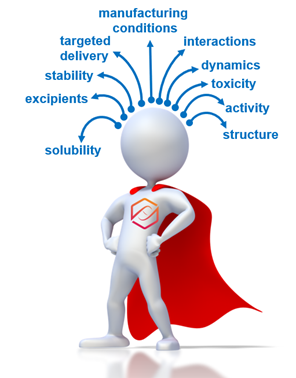
Schematic representation of a BIOPHAM student facing complex drug discovery and development challenges. Track 3 equips students with the biophysical skills and interdisciplinary knowledge required for success. His/her key strength will be a unique, multifaceted (illustrated by arrows) expertise that will allow him/her to anticipate and effectively solve problems relevant to pharmaceutical development by taking into account the molecular and physical conditions of a given material, therapeutic approach, or production process.