Term 2 – Soft Matter, Drug Materials, Large Facilities, and Research Practice
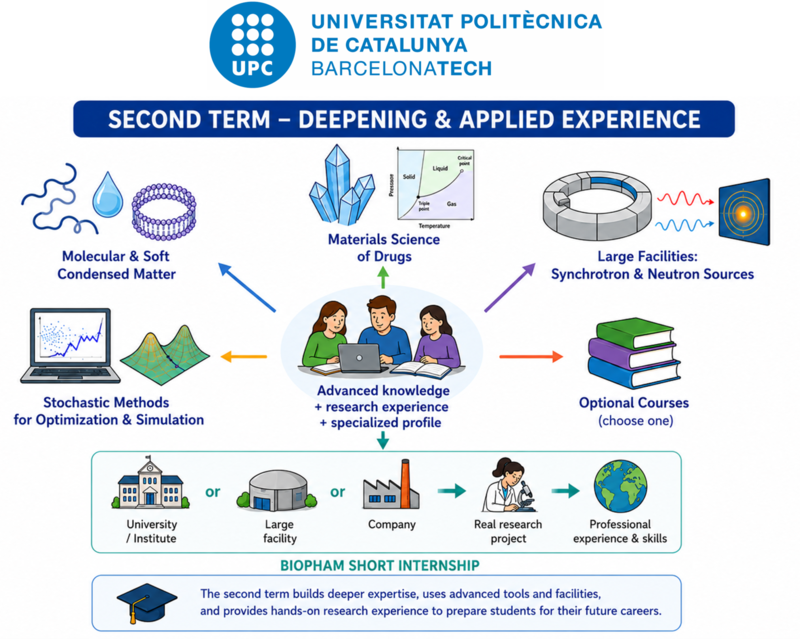
The second term, hosted by the Polytechnic University of Catalonia, deepens and diversifies the students’ expertise. It brings together molecular and soft condensed matter physics, drug materials science, large-scale characterization facilities, stochastic methods, and applied research experience.
The course on Molecular and Soft Condensed Matter introduces the physics and chemistry of disordered and dynamic systems such as liquids, glasses, polymers, liquid crystals, gels, surfactant systems, and biomembranes. Students study entropy, free energy, phase transitions, crystallization, glass transition, viscoelasticity, molecular dynamics, self-assembly, polymer networks, hydrogels, organogels, emulsions, and controlled drug release. This course highlights the importance of soft matter systems in pharmaceutical formulation, biological structure formation, and drug delivery applications.
In Materials Science of Drugs, students focus on crystallography, polymorphism, phase equilibrium, phase transitions, binary systems, thermodynamic potentials, phase diagrams, metastability, instability, solubility, miscibility, nucleation, and spinodal decomposition. These topics are essential for understanding the solid-state behaviour of drug molecules and their relevance to formulation stability and performance.
A distinctive feature of the second term is the course on Large Facilities: Synchrotron and Neutron Sources. Students learn about particle accelerators, X-ray and neutron sources, scattering, diffraction, beamlines, inelastic neutron scattering, X-ray absorption fine structure, synchrotron imaging, and data analysis. This course gives students insight into the powerful research infrastructures used to investigate the structure and dynamics of pharmaceutical and soft matter systems at advanced levels.
The computational component continues with Stochastic Methods for Optimization and Simulation, where students learn Monte Carlo integration, variance reduction, Metropolis sampling, simulated annealing, genetic algorithms, optimal control, Brownian dynamics, Langevin and Fokker–Planck approaches, and quantum Monte Carlo methods. These tools are essential for tackling complex physical, chemical, and pharmaceutical systems where deterministic methods may be insufficient.
The second term also includes a BIOPHAM Short Internship, giving students the opportunity to participate in a research or industrial project in a university, research institute, large facility, or private company. This internship allows students to apply their knowledge in a professional environment, develop autonomy, and experience the research and development settings targeted by the Erasmus Mundus programme.
Students also choose optional courses from a set that includes Complexity in Biological Systems, Biophysical and Materials Science Characterization, and Machine Learning with Neural Networks. These options allow students to tailor their profile toward biophysics, experimental characterization, or advanced artificial intelligence methods. Topics include biological networks, biosignal analysis, self-organization, electrolyte and non-electrolyte solutions, microscopy, spectroscopy, chromatography, nanoparticle characterization, neural networks, convolutional networks, recurrent networks, support vector machines, Boltzmann machines, and deep learning.
Course catalogue available here