Term 1 – Foundations in Pharmaceutical Materials Science
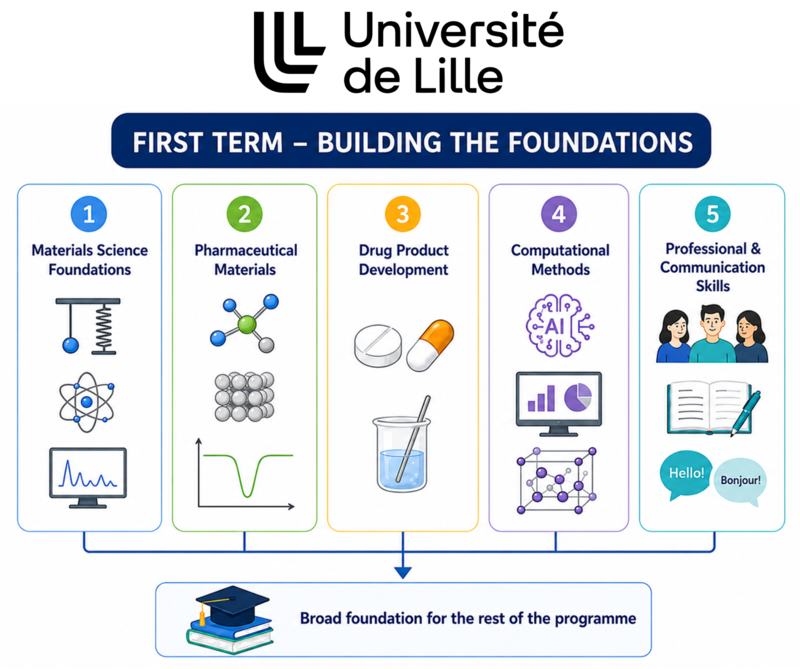
The first term, taught at the University of Lille, establishes the scientific and technical foundations of the track. Students begin by studying the fundamental behaviour of materials through courses such as Continuum Mechanics, States of Matter and Materials Science Primers, and Introduction to Pharmaceutical Materials Science. These courses introduce essential concepts including stress and strain, elasticity, crystalline and amorphous states, polymers, metals, ceramics, molecular interactions, structural organization, thermodynamics, phase transformations, and experimental characterization methods such as X-ray diffraction and differential scanning calorimetry.
A central component of this term is the introduction to pharmaceutical materials themselves. Students explore atoms, molecules, ions, functional groups, intermolecular interactions, ordered and disordered structures, polymorphism, amorphous materials, phase diagrams, miscibility, solubility, eutectic systems, calorimetry, and thermal analysis. This provides the basis for understanding how the physical state and structure of a material influence its pharmaceutical behaviour.
The term also introduces students to drug product development and pharmaceutical technology. This course connects materials science with practical pharmacy by covering dosage forms such as tablets, capsules, pellets, creams, ointments, microparticles, and implants. Students learn about active pharmaceutical ingredients, excipients, formulation strategies, manufacturing routes, and quality control methods required by European and United States pharmacopeias. Practical training includes preparation techniques such as granulation, compression, and film coating, as well as characterization methods including dissolution, disintegration, hardness, friability, particle size, and powder flow measurements.
Computational and data-driven approaches are introduced early in the curriculum. The course on AI and advanced computational methods in physics familiarizes students with artificial intelligence, machine learning, supervised and unsupervised learning, regression, classification, clustering, dimensionality reduction, neural networks, deep learning, data preprocessing, and physics-informed machine learning. In parallel, Atomic Scale Modeling I – Classical Methods introduces molecular dynamics, Monte Carlo methods, force fields, optimization techniques, thermostats, barostats, periodic boundary conditions, and statistical analysis of simulation outputs. These courses ensure that students acquire practical computational skills that complement experimental approaches.
The first term also includes Tutored Trainings, a course designed to develop autonomy, literature analysis, scientific writing, oral presentation, and peer communication. Students work in pairs on topics derived from the scientific literature, producing reports and presentations under academic supervision. A graduate programme course and foreign language training further support students’ academic, professional, and international development. By the end of the first term, students have built a broad and coherent foundation in the physical, pharmaceutical, computational, and communication skills required for the rest of the programme.
Course catalogue available here