Term 3 – Advanced Specialization in Pharmaceutical Materials
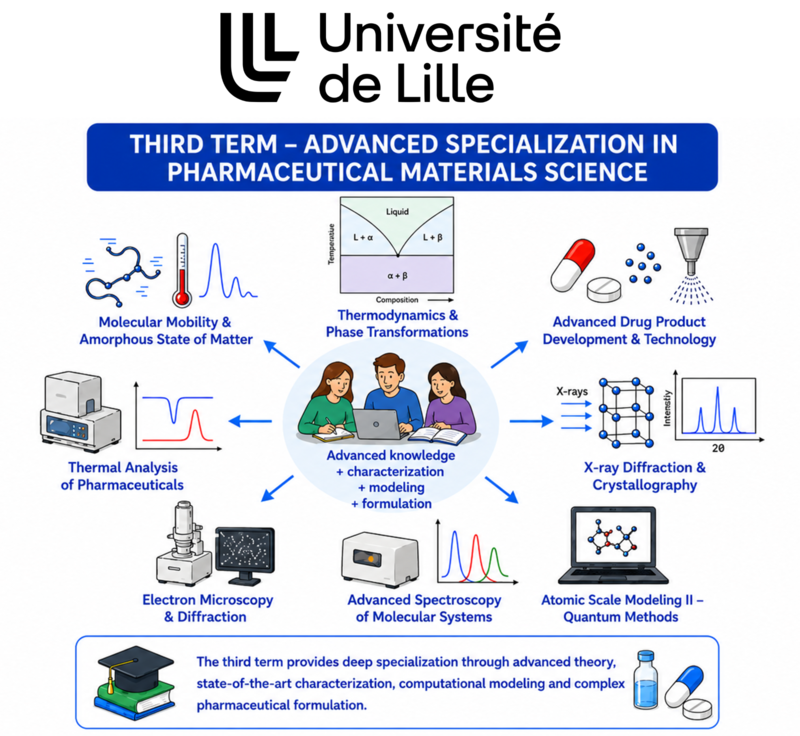
The third term returns to the University of Lille and provides advanced specialization in pharmaceutical materials science. It builds on the knowledge acquired in the first two terms and focuses on the physical states, transformations, molecular dynamics, characterization, and formulation of complex pharmaceutical systems.
The course on Advanced Thermodynamics and Phase Transformations provides a theoretical framework for understanding equilibrium and out-of-equilibrium condensed states. Students study crystalline polymorphs, amorphous forms, metastability, instability, binary phase diagrams, Gibbs free energy, binodal and spinodal decomposition, eutectic systems, nucleation and growth, interfaces, Avrami models, time-temperature-transformation diagrams, glass transition, vitrification, and modern theories of glasses.
In Molecular Mobility and Amorphous State of Matter, students examine molecular motions in supercooled liquids, glassy materials, semi-crystalline systems, and mesophases. They learn how to analyze relaxation processes using dielectric relaxation spectroscopy, thermo-stimulated currents, and dynamic mechanical analysis. This course is particularly important for understanding the stability, dynamics, and properties of amorphous pharmaceutical materials.
The pharmaceutical technology sequence continues with Drug Product Development and Pharmaceutical Technology II, which addresses more complex formulation challenges. Students study poorly water-soluble drugs, controlled-release systems, amorphous solid dispersions, self-micro-emulsifying drug delivery systems, nanocrystals, biodegradable implants, microparticles, coated dosage forms, hot-melt extrusion, spray drying, dissolution testing, drug release mechanisms, long-term stability, and industrial-scale manufacturing issues.
Several courses are devoted to advanced characterization. Thermal Analysis of Pharmaceuticals trains students in thermogravimetric analysis, differential scanning calorimetry, modulated DSC, glass transition analysis, melting, crystallization, degradation, demixing, miscibility, and amorphous content quantification. Structural and Dynamical Characterization of Pharmaceuticals combines experimental and numerical methods, including Raman scattering, optical microscopy, powder X-ray diffraction, dielectric relaxation spectroscopy, molecular dynamics, density functional theory, COSMO-RS, and machine learning. Students learn to apply complementary tools to investigate crystal structures, amorphous phases, polymorphism, co-crystals, microstructure, molecular mobility, and formulation heterogeneity.
The course on Structural Properties of Matter: Electron Microscopy and Diffraction introduces scanning and transmission electron microscopy, powder X-ray diffraction, Rietveld analysis, electron-matter interactions, imaging, chemical analysis, spectroscopy, and diffraction. Students gain hands-on experience with SEM, TEM, and diffraction data processing. Advanced Spectroscopy of Molecular Systems: From Gas Phase to Condensed Matter provides training in Raman, neutron, FTIR, microwave, and dielectric spectroscopy, connecting molecular signatures to structural and dynamic properties across different physical states.
The computational sequence concludes with Atomic Scale Modeling II – Quantum Methods, where students learn how quantum methods are used to solve electronic structure problems in molecular systems and solids. Topics include the Schrödinger equation, Hartree-Fock theory, basis sets, pseudopotentials, semi-empirical methods, DFTB, post-Hartree-Fock methods, density functional theory, hybrid quantum/classical techniques, geometry optimization, vibrational spectra, band structures, phonons, transition states, and reaction rates.
Course catalogue available here